The Top-Five Things I learned as a First-Time Attendee at SABCS 2025 by Sara Zimov
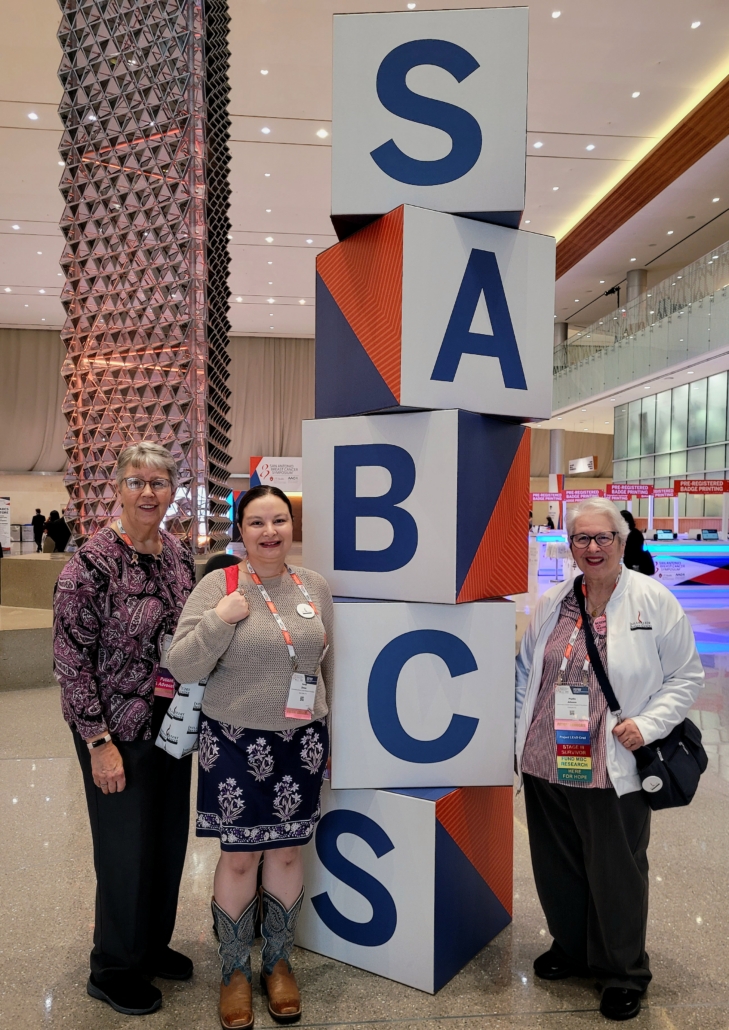
Walking into the San Antonio Breast Cancer Symposium (SABCS) for the first time this December was pleasantly overwhelming. There were 11,000 attendees from 102 countries, all focused on advancing breast cancer science! Here are the top five takeaways most relevant to our IBC community.
1. IBC Finally Has Diagnostic Codes—A Game-Changing Achievement
The biggest announcement at SABCS 2025 was the successful effort of the IBC Collaborative to create specific ICD-10 diagnostic codes for inflammatory breast cancer. These codes went into effect on October 1, 2025.
The three codes—C50.A0 (unspecified inflammatory carcinoma of breast), C50.A1 (inflammatory carcinoma of right breast), and C50.A2 (inflammatory carcinoma of left breast)—mark a major win for the IBC community. Led by our own IBCRF in collaboration with Susan G. Komen and the Milburn Foundation, this achievement means IBC is no longer buried within general breast cancer codes.
Lindsey Anstine, Ph.D., presented strong data illustrating why this matters. Healthcare providers can now accurately document IBC in medical records, which helps with tracking prevalence, outcomes, and treatment patterns. Researchers can find IBC patients in databases more accurately. Insurance companies and healthcare systems can understand IBC’s specific treatment requirements. Most importantly, patients may receive correct diagnoses more quickly, avoiding dangerous delays that occur when IBC is misdiagnosed.
2. The IBC Scoring System Is Revolutionizing Diagnosis
An equally important change is the adoption of the IBC Scoring System. Since its launch in August 2023, it has been used over 6,000 times in 114 countries. This tool tackles a key issue: even experienced clinicians often disagree on the diagnosis of IBC because it has been subjective. Physicians sometimes argue about whether the breast is “inflamed enough” to qualify as IBC.
The scoring system makes diagnosis more objective by evaluating clinical, pathologic, and imaging characteristics on a scale from 0 to 48. Each characteristic gets a score between 0 and 3, which is then multiplied by a priority factor that values features specific to IBC more heavily. The total score helps classify patients into categories like “definite IBC” (highest scores), “strong possibility,” or “locally advanced breast cancer.”
At SABCS, Dr. Anstine reported that more tumor boards and multi-institutional networks are using the tool, indicating it is practical for clinicians. The online calculator at komen.org/ibc makes it easy for providers worldwide to access the tool.
This is important because correct diagnosis leads to appropriate treatment. IBC needs aggressive trimodal therapy—neoadjuvant chemotherapy, mastectomy, and radiation—right from the start. Patients misdiagnosed with less aggressive disease may get inadequate initial treatment, allowing the cancer to spread.
3. Patient Advocates Shape Research—Not Just Observe It
I was curious about the role of advocates at a scientific conference like this. It turns out, we are essential to the research process.
Twenty-four patient advocates participated as panelists and speakers in the scientific program, with four on the SABCS 2025 Program Committee. This involvement ensures that patient viewpoints influence which research is funded, how studies are structured, and how findings are communicated.
The Advocate Lounge became my home base during the conference. Conversations there went beyond science to real-world implications. These stories are why advocates fought for a decade to establish IBC’s own diagnostic codes. They’re why the scoring system is so important. We’re not only translating research; we’re making sure it addresses the real issues that endanger lives.
4. The IBC Research Task Force Is Charting the Path Forward
Dr. Anstine’s presentation highlighted systematic efforts to identify knowledge gaps in IBC biology through the IBC Research Task Force convened by the IBC Collaborative. This expert panel is figuring out what we need to learn about how IBC starts, spreads, and how it can be monitored—insights that will direct future funding towards IBC-specific questions.
This is crucial because IBC makes up 2-4% of breast cancer diagnoses but accounts for 10% of breast cancer deaths. It has a far greater impact on mortality than its numbers suggest. Yet it has been greatly understudied.
The IBC Research Task Force is prioritizing questions such as: What drives IBC’s rapid growth? Why does it spread into dermal lymphatics so easily? Can we find biomarkers for early detection? How can we monitor treatment response more effectively?
5. Precision Medicine Advances Offer Hope for IBC
Several themes from SABCS 2025 have direct implications for IBC patients, particularly regarding more precise diagnosis and treatment monitoring.
Liquid biopsy technology, which detects circulating tumor DNA in the blood, was a hot topic at the conference. For IBC, where close monitoring is vital, the ability to find minimal residual disease early and identify resistance mutations as they appear could be groundbreaking. Real-time monitoring of treatment response can allow for therapy adjustments before clinical progression is evident.
Research presentations also highlighted new treatment targets, including TROP2 and CCR7. The expanding treatment options provide hope for appropriate patients, including those with IBC, whose cancers do not respond to standard therapies.
Final Reflections
With new diagnostic codes that enable accurate documentation, a validated scoring system that standardizes diagnosis, dedicated research task forces identifying knowledge gaps, and major cancer centers investing in IBC programs, IBC is beginning to receive the attention it deserves.
For advocates thinking about attending SABCS: the conference genuinely values patient voices. Lower registration fees, dedicated lounges, and integrated patient involvement show that SABCS understands we are essential partners in research, not just recipients.
My first SABCS left me inspired by thousands of researchers and advocates working toward better outcomes—and reminded of how much we still need to learn about IBC. But after seeing the new diagnostic infrastructure finally in place, I’m convinced more now than ever that we are moving fast in the right direction.
References
- SABCS 2025. San Antonio Breast Cancer Symposium Homepage. https://sabcs.org/
- Anstine L, et al. Susan G. Komen-Led Research Spotlighted at SABCS 2025. Poster PS5-11-17. SABCS, December 9-12, 2025. https://www.komen.org/blog/komen-led-research-sabcs-2025/
- Murray S, et al. TROP2 expression and therapeutic opportunities in inflammatory breast cancer. Poster PS1-09-12. SABCS, December 10, 2025.
- Shivhare S, et al. Characterizing CCR7 gene amplification and protein expression in inflammatory and non-inflammatory breast cancer. Poster PS4-01-10. SABCS, December 11, 2025.
- SABCS Meeting News. Explore the full SABCS 2025 program now. https://www.sabcsmeetingnews.org/
- Jagsi R, Mason G, Overmoyer BA, et al. Inflammatory breast cancer defined: proposed common diagnostic criteria to guide treatment and research. Breast Cancer Res Treat. 2022 Apr;192(2):235-243. doi: 10.1007/s10549-021-06434-x